
Collision Center 1 Prior Lake is publishing consumer guidance that gives drivers a more concise framework for understanding fender damage after a side impact. The October guidance focuses on four factors that can determine the repair approach: the condition of the fender itself, its alignment with neighboring components, the wheel-opening and attachment areas, and vehicle-specific repair requirements.
Information about the facility is available through the Collision Center 1 Prior Lake location page.
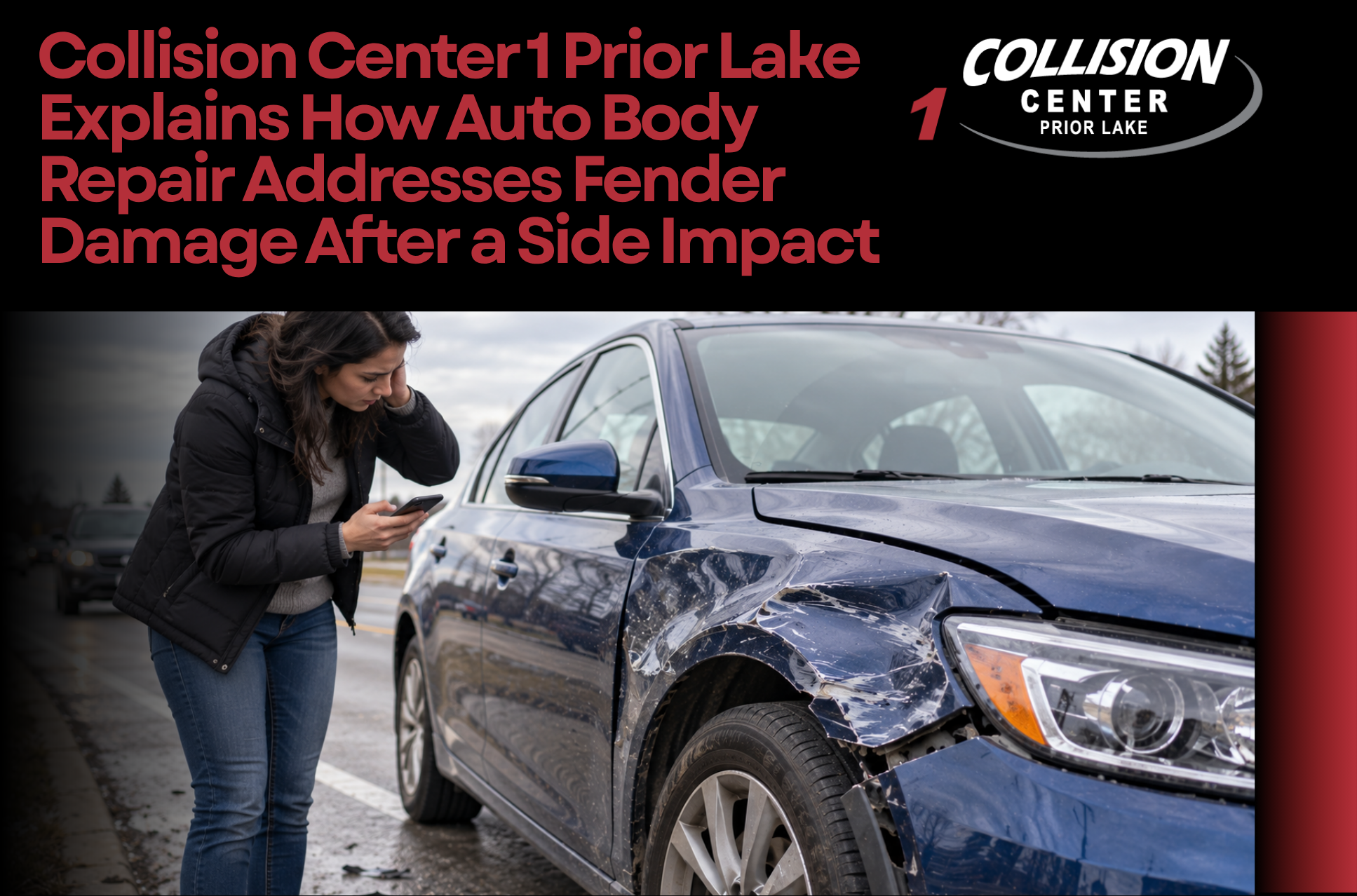
Fenders occupy the area around the front wheel opening and can be damaged during sideswipes, parking-lot impacts, and front-corner collisions. Damage may appear as a shallow dent, sharp crease, scrape, damaged paint, or a change in how the fender fits with surrounding components.
The first consideration is the condition of the fender. Dent shape, depth, location, panel material, paint condition, and accessibility can influence whether conventional body repair, paintless dent repair, or replacement is appropriate.
A broad dent can present different repair conditions from a sharp crease even when both cover a similar area. Damage near a body line, panel edge, or attachment point can also require a different approach from damage in the center of the panel.
Through auto body repair services, the repair method can be selected according to the documented condition of the individual component rather than dent size alone.
The second consideration is alignment. A front fender fits in relation to the hood, front door, bumper, headlamp, and wheel opening. Following a side impact, technicians may find that the gap between the fender and door has changed or that the fender no longer meets the bumper or hood evenly.
A changed gap does not automatically mean the fender is solely responsible. Brackets, retainers, mounting points, bumper components, lamp mounting areas, or neighboring panels can contribute to the visible change.
The wheel-opening and attachment areas provide the third part of the evaluation. A displaced fender can affect clearance around the wheel opening, while liners, trim, or attachment hardware may also be involved. Technicians can evaluate these components separately rather than assuming every nearby part was damaged.
When exterior components restrict access, limited disassembly may be used to inspect attachment locations or other areas relevant to the documented impact. Additional access does not presume concealed damage. It provides information when the exterior view is insufficient to establish the repair plan.
Vehicle-specific information is the fourth consideration. Fender materials can vary by vehicle, including different types of steel and aluminum. Applicable manufacturer repair information can help identify procedures appropriate for the specific panel and vehicle.
Modern vehicle technology can add another vehicle-specific factor around the front corner. Depending on the model, nearby bumpers, lamps, grilles, mirrors, or other components may contain or interact with cameras, sensors, radar equipment, or wiring. Fender damage alone does not establish that these systems were affected. Diagnostic or calibration procedures apply only when identified for the particular vehicle and repair.
If the fender can be repaired, technicians can restore the physical panel condition before completing applicable surface preparation and refinishing. If replacement is required, the new component can be fitted in relation to the hood, door, bumper, headlamp, and wheel opening before the repair is completed.
The collision repair process can also address other documented components when the side impact extends beyond the fender. This keeps the repair plan tied to confirmed conditions rather than assumptions based on exterior appearance.
The October guidance is intended to help drivers understand why two similar-looking fender dents can result in different repair plans. Differences in deformation, paint condition, material, attachment areas, panel alignment, and neighboring components can change the appropriate repair method.
For vehicle owners, the main takeaway is that fender repair after a side impact is not determined by the dent alone. Evaluating the panel, its fit, attachment areas, wheel opening, and applicable vehicle-specific information provides the basis for deciding whether repair or replacement is appropriate.
Collision Center 1 Prior Lake is located at 16111 Main Ave SE, Prior Lake, MN 55372. The facility provides auto body and collision repair services for Prior Lake-area drivers as part of Collision Center 1.
###
For more information about Collision Center 1 Prior Lake, contact the company here:
Collision Center 1 Prior Lake
Jerald Stiele
(952) 447-4259
layres@collisioncenter1.com
16111 Main Ave SE, Prior Lake, MN 55372