New Zywave Research Finds AI Set to Unlock More Than $100 Billion in Annual Value Through Transformed Insurance Distribution
PR Newswire
MILWAUKEE, Oct. 27, 2026
The Broker of the Future study finds AI-native brokerages capable of operating at six times the revenue per employee of traditional agencies, even as the industry faces its sharpest talent shortage in decades
MILWAUKEE, Oct. 27, 2026 /PRNewswire/ -- Zywave, a leading technology provider for insurance distribution, today released The Broker of the Future, a new study of the U.S. insurance distribution market finding that AI is set to unlock more than $100 billion in annual value for carriers and brokers within the next five to seven years, not by replacing the broker, but by rewriting the economics of how risk gets priced, serviced, selected, and covered.
The research, which analyzed employment trends, commission structures, and technology adoption across the industry, answers the question nearly every carrier and broker executive has faced in the last year: will AI replace the broker? The data says no. Insurance remains a high-consequence product that must be sold, not bought. The real value brokers deliver is not processing forms but providing judgment, uncovering the hidden context between what a client says they need and what they're actually exposed to. Additionally, no insurer has emerged to underwrite an AI system's mistake at the point of bind, signaling the importance of a licensed human remaining in the review seat.
The study finds the real risk isn't replacement, but a worsening talent shortage. The U.S. Bureau of Labor Statistics projects that roughly 400,000 insurance professionals will have retired since 2021 by the end of this year, with not enough new talent coming in to replace the judgment and experience they take with them.
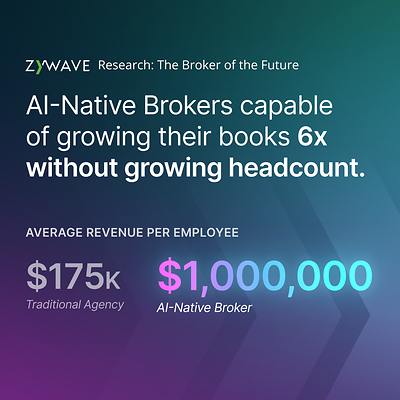
At the same time, the study identifies a stark economic gap that is already separating winners from laggards: a traditional insurance agency runs on roughly $175,000 of revenue per employee, while an AI-native broker is proving it is capable of running at closer to $1,000,000, nearly six times as much. In other words, these firms are growing their business faster than they're growing their headcount, versus reducing staff.
"Every carrier and broker executive we talk to has asked some version of the same question: is AI coming for the broker's seat at the table?" said Martin Simoncic, Chief Executive Officer at Zywave. "The answer is no, but that's far from permission to stand still. The data is unambiguous: the brokers and carriers who invest to unlock the value in their own data, fix the foundation underneath it, and put AI to work on the paperwork rather than the judgment are already operating at a different level of economics than everyone else."
The $100 billion opportunity breaks down across four structural shifts already underway across the industry:
- Carriers price on live data ($10–20B/year) — continuous underwriting against real-time inputs rather than a once-a-year snapshot.
- Software takes over the back office ($30–40B/year) — AI absorbs the clerical core of distribution work that today requires more than half the industry's workforce.
- Better risk selection and fraud detection ($20–30B/year) — carriers are already paying significantly more in contingent commission for a well-selected book.
- New AI risks become new, insurable coverage ($15–20B/year) — a new specialty line tracking the same growth curve that took cyber insurance from zero to $15 billion in premium.
This $100 billion opportunity will reward some firms more than others. Three trajectories are already emerging: the largest national and super-regional brokerages are consolidating premium and talent at scale; small and mid-sized agencies, the most exposed if they don't modernize, are becoming acquisition targets; and specialists are pulling away by going deeper into a defensible niche rather than competing on size. Regardless of size, brokers that choose to maintain the status quo will be left behind.
"The carriers and brokers positioned to win aren't necessarily the ones spending the most on AI, they're the ones who invest to get their own data in order first," said Eric Rentsch, Chief Product Officer and Head of Emerging Markets at Zywave. "Every archetype in this study, whether you're scaling, specializing, or deciding whether to sell, wins or loses on that same foundation. The Broker of the Future research provides a clear roadmap for how the industry can capitalize on the sizable opportunity ahead."
Download the Research
The first half of The Broker of the Future, analyzing the market transformation, is available now at www.zywave.com/resources/the-broker-of-the-future-report. A companion playbook, detailing the new distribution operating model and specific moves carriers and brokers can make to capture this opportunity, is also available at the same link.
About Zywave
Zywave is transforming the growth model for insurance. Its Apex™ AI platform helps carriers, brokers and agents take smarter, faster actions to win, retain and grow customers, supported by a global ecosystem of 15,000 customers and partners. Learn more at www.zywave.com.
Media Contact
Ashley Paula-Legge
Big Valley Marketing for Zywave
ashley.paulalegge@zywave.com

 View original content to download multimedia:https://www.prnewswire.com/news-releases/new-zywave-research-finds-ai-set-to-unlock-more-than-100-billion-in-annual-value-through-transformed-insurance-distribution-302920900.html
SOURCE Zywave